Driving on small routes, first through sun-baked, red-earthed vineyards, then through narrow mountain passes with astonishing cliffs jutting up on one side of the road, and plunging down on the other side, and also through green, green valleys, was one (surprising) highlight of the vacation. I was so happy to explore in this new way, more or less free to do what I wanted and go where I wanted. I was happy not too many other cars were on the roads, and I could take my time - both for sight-seeing and so I wouldn't careen off the road on any one of the hundreds of sharp switch-backs! It was both thrilling and relaxing at the same time.
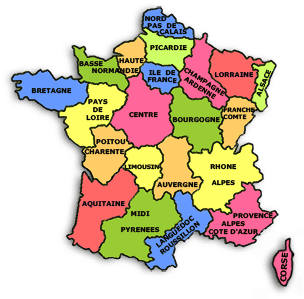
The point of my two-day adventure was to visit a bunch of medieval castles - or more frequently their ruins. Now, without getting into an extensive history lesson here, these sites are of interest because of their long and often complicated history involving catharism, the Albigensian Crusade, and later the protection of the southern French border with Spain. First, the Cathars were a religious sect that developped primarily in the Languedoc region in the 1000s and lasted mostly through the 1200s. Their religious principles put them at odds with the Catholic Church, and the Church's desire to get rid of the heretics led to the Albigensian Crusade, from 1209-1229. This crusade is unique in that it was the only one faught on European soil, by Europeans against Europeans. Long story short, people were tortured, villages and castles sieged, and eventually it was declared that the heresy was wiped out, and by the end of the 1400s, records of inquisitorial action against Cathars basically stop.
After the Crusade, many formerly Cathar fortresses were turned into border fortresses, and more fortresses were built, serving as border protection along the Franco-Spanish border, which until 1659 was much further north than current day. With the signing of the Treaty of the Pyrenees in 1659, the border was pushed back to where it is today, along the peaks of the Pyrenees Mountains.
 Le château de Montségur
Situated on a pog, from the Occitan (dialect of the region) word for "peak," Montségur is a bit of a hike up a steep and rocky path. Aside from the volumes of history that have been written about this place, what impressed me the most was how it was even possible for people to construct a fortress and village on this peak. I mean, we're talking way pre-Industrial Revolution! Plus, the fortress that remains today is not the first (pre-1200), nor even the second (1210), but the third built on that site. Not only did they construct the fortress, but some 200+ people lived in the mountain-top village, and took refuge within the castle walls during four sieges. The first three (1212, 1213, 1241) were never successful, but the fourth, started in 1242, lasted until 1244 when the besieging forces finally overtook the fortress and burned at the stake 220 Cathars.
 Northwest tower containing the dungeon and cistern
 Southern wall, built right into the natural rock formations of the pog.
 Dungeon and cistern
 Dungeon and cistern
 Remains of the village perched outside of the north wall of the castle
 View from the pog
 Memorial to the Cathars burned at the stake in 1244
Castle ruins #2 was, for me, a really incredible place to visit because I first read about this itty bitty village in a medieval history class sophomore year. The village of Montaillou was the subject of an extensive inquisition in the early 1300s, when the local bishop decided this "last bastion" of heresy needed to be put to an end. In 1309 the entire village was arrested and questioned on every minute detail of their lives, and their testamonies were faithfully recorded. It just so happened that this bishop then went on to become Pope Benedict XII, and he brought the written records from his inquisition in Montaillou to the Vatican with him. Thus, they were preserved.
It is extremely rare that such detailed and complete records of daily life in the Middle Ages have been conserved until the modern day. In the mid 1900s, French historian and author, Emmanuel Le Roy Ladurie wrote a "microhistory" of the village based on the preserved testamonies, in which he synthesized the information and layed out a (sometimes painfully) detailed picture of life in Montaillou from 1294-1324. We used this work in class sophomore year, and I'm currently reading the original (and complete) French version.
 Ruins of le château de Montaillou
 The barely three remaining walls were from the dungeon of the castle
 Dwelling remains
Just behind the dungeon walls are low remains of the castle's protective wall, as well as remains of several dwellings located within the walls.
 Le château de Montaillou
From the furthest protective wall's remains. This whole hill top would have been enclosed within the castle walls.

No comments:
Post a Comment